When water damage strikes a property, the drying process becomes a race against time—not just for the structure, but for the accuracy of the insurance claim itself. The Dri-Eaz GRL-2000 Grilla Max, a high-velocity, low-energy heated air mover, has emerged as a critical tool for restoration professionals who need to meet drying standards and produce defensible documentation. This article explores how this specific piece of equipment directly influences insurance claims advice, helping policyholders and adjusters alike verify that drying protocols meet industry benchmarks.
How Does the Dri-Eaz GRL-2000 Grilla Max Affect Insurance Claim Documentation?
Insurance adjusters require conclusive proof that a property has been dried to a safe moisture content before authorizing rebuilds or paying for secondary repairs. The Grilla Max, with its high-efficiency ECM motor and integrated heat assist, allows contractors to create a controlled drying environment that accelerates evaporation without introducing excessive heat that might damage sensitive materials. For claims, this means daily monitoring logs often show faster psychrometric improvements—lower relative humidity and elevated vapor pressure—directly correlating to shorter drying times. Insurers frequently ask for documentation that drying equipment was used continuously and effectively; a contractor’s use of the GRL-2000 carries weight because it is a recognized tool in the industry. The unit’s HEPA filter option (available as an accessory) also helps prevent cross-contamination, which is a common point of concern in mold-related claims.
Can the Grilla Max Actually Reduce the Overall Cost of a Water Damage Claim?
Yes, but indirectly. The upfront cost of renting or purchasing high-performance air movers like the Grilla Max often leads to lower total claim amounts because drying cycles are shorter. Standard axial fans might require 5–7 days to dry a flooded carpet and pad; the Grilla Max’s heated output can achieve the same result in 3–4 days under similar conditions. Fewer days of drying means lower labor costs, reduced equipment rental fees, and less disruption to the insured’s life. Insurance companies see value in minimizing additional living expenses (ALE) and temporary housing costs. Furthermore, because the Grilla Max consumes approximately 5.2 amps at 120V (around 600 watts on high with heat engaged), it does not overload household circuits as easily as older units, reducing the risk of electrical claims or the need for expensive generator rentals in storm scenarios. For claims adjusters, a drying log showing consistent use of low-amp, high-performance equipment is a sign of efficient resource management.
Is the Dri-Eaz GRL-2000 Grilla Max Accepted by All Major Insurance Carriers for Drying Protocols?
No major insurance carrier in the United States or United Kingdom publishes a specific list of approved equipment brands. However, the Grilla Max is widely accepted because it meets the ANSI/IICRC S500 standard for water damage restoration. The unit delivers up to 1,700 CFM (cubic feet per minute) on high speed, with a targeted air velocity that meets the industry requirement of 1,000–2,000 feet per minute across wet surfaces. Its heat output—up to 15,000 BTU—can raise the temperature of a contained drying chamber by 10–15°F (5–8°C), which accelerates evaporation without risking material degradation. Adjusters trained in IICRC protocols look for these metrics on daily reports. The Grilla Max’s ability to run on a standard 15-amp circuit while providing heated air means restoration firms can deploy multiple units without needing electrical upgrades. This scalability is particularly valued in large-loss claims where time and logistical simplicity are paramount. For a deeper dive into how this model compares to another top-tier option, see our Dri-Eaz GRL-2000 Grilla Max vs Phoenix R200 Max Air Mover for Mold Control article.
How Does the Grilla Max Help Prevent Mold-Related Denials in Insurance Claims?
Mold is the single most common reason for insurance claim rejections or limitations on water damage policies. Many standard homeowner policies exclude mold remediation unless it is a direct result of a covered peril (like a sudden burst pipe). By drying structural cavities quickly—within 48 to 72 hours—the Grilla Max reduces the window in which mold spores can colonize. Restoration firms using this unit often provide daily moisture readings that show when materials reached < 15% moisture content, which is the threshold below which mold cannot grow. This documentation directly supports the argument that the water damage was mitigated promptly. If a policyholder’s claim is later disputed over mold concerns, a well-maintained drying log featuring the GRL-2000’s performance can be powerful evidence. For further context on storm-related mold prevention, read our guide on Dri-Eaz GRL-2000 Grilla Max: Preventing Mold After Storms?.
What Specific Claim Metrics Can Be Improved by Using the Grilla Max in Restoration?
| Metric | Without Grilla Max (Standard Axial Fan) | With Dri-Eaz GRL-2000 Grilla Max | Impact on Claim |
|---|---|---|---|
| Drying time (Class 3 water, medium pile carpet) | 5–7 days | 3–4 days | Reduced labor & equipment costs; lower ALE payouts |
| Electrical load per unit | 7–10 amps (1,500W heaters) | 5.2 amps (600W with heat) | Fewer circuit breakers tripped; fewer electrical claims |
| Airflow at floor level (CFM) | 800–1,200 CFM | 1,700 CFM | Faster evaporation of subfloor moisture |
| Heat output | None or low (5,000 BTU) | 15,000 BTU | Higher vapor pressure differential; faster drying |
| Noise level | 75–80 dB | 68–72 dB | Less disruption; fewer ALE claims for hotel stays |
The table above illustrates clear advantages that translate into quantifiable benefits for both the restoration contractor and the insurance adjuster. Faster drying times alone can reduce the total claim by hundreds of dollars per day in labor and equipment rental fees.
How Should a Policyholder Verify That a Restoration Crew Used the Grilla Max Correctly for Their Claim?
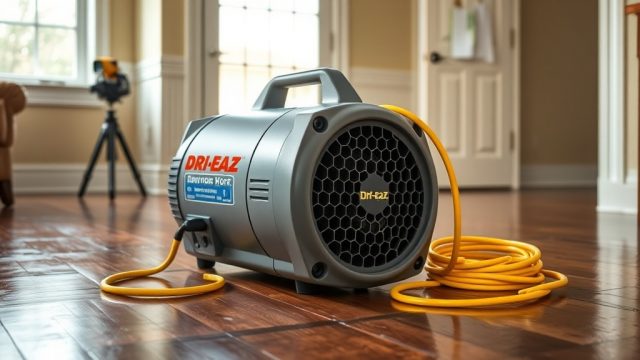
Policyholders do not need to become drying experts, but they can ask three key questions: (1) Are you using heated low-amp air movers like the Dri-Eaz Grilla Max to dry hardwood or subflooring? (2) Can you show me your daily psychrometric readings, including temperature, relative humidity, and moisture content? (3) Is your drying plan consistent with IICRC standards? Most reputable restoration firms will provide a detailed drying log. The Grilla Max is distinctive by appearance—its yellow and black design with a large rear handle is hard to miss. The unit also features a simple control panel with high/low/heat settings. If a crew uses older non-ECM units, request an explanation. Insurance companies often reimburse based on documented equipment usage; if the contractor uses substandard gear, the claim may pay less for drying time but the insured could be left with lingering moisture. For a complete review of this tool’s capabilities, consult our Dri-Eaz GRL-2000 Grilla Max Heated Air Dryer Review: Best for Water Damage Restoration?.
What Owners Say
Restoration business owners and field technicians consistently praise the Grilla Max for its reliability in harsh conditions. One certified water damage specialist in Florida reported that the unit reduced drying time for a flooded kitchen by nearly 40% compared to their previous axial fans, which allowed them to close the claim five days earlier. An owner of a mid-sized restoration company in Texas noted that using four Grilla Max units on a large residential flood resulted in the adjuster complementing the drying documentation for its clarity and speed. Some users mention that the heat setting can be too aggressive for delicate surfaces like vinyl plank—though proper monitoring mitigates this risk. For more real-world testing, see our comparison piece: Dri-Eaz GRL-2000 Grilla Max vs Phoenix R200 Max Air Mover for Mold Control.
Frequently Asked Questions
Q: Does the Dri-Eaz GRL-2000 Grilla Max meet insurance carrier drying requirements?
A: Yes. It complies with IICRC S500 standards and delivers sufficient CFM and heat to achieve documented drying progress, which is what insurers require for claim approval.
Q: Can the Grilla Max be used on hardwood floors without causing damage?
A: Yes, with careful monitoring. The heat output is adjustable, and technicians should keep surface temperatures below 95°F (35°C) to avoid cupping or cracking. Proper air movement is more critical than heat alone.
Q: How does the Grilla Max affect additional living expense (ALE) claims?
A: By shortening drying time, the Grilla Max reduces the duration an insured family might need temporary housing, directly lowering ALE payouts from the insurance company.
Q: Is the Grilla Max suitable for leak detection follow-up?
A: Yes. After a leak is found and repaired, the Grilla Max can dry the affected area quickly, preventing secondary damage and mold. See our guide: Dri-Eaz GRL-2000 Grilla Max for Leak Detection: A Comprehensive Guide.
Q: Will using a Grilla Max guarantee my claim is approved?
A: No equipment guarantees claim approval. However, proper use of high-performance drying tools like the Grilla Max provides the documentation adjusters need to approve coverage for drying and structural repairs.
Q: Can I rent a Grilla Max directly, or must a contractor use it?
A: You can rent one from equipment suppliers, but for insurance purposes, it is best to have a certified restoration professional operate it and maintain the drying log.