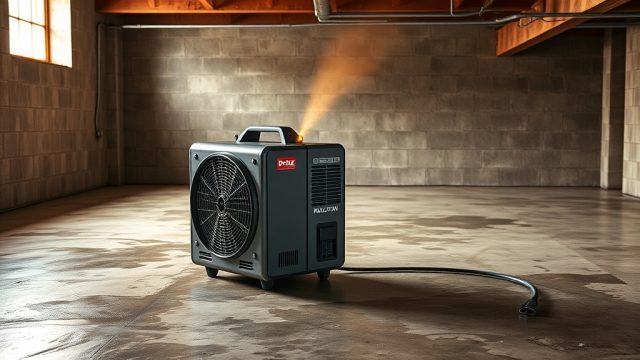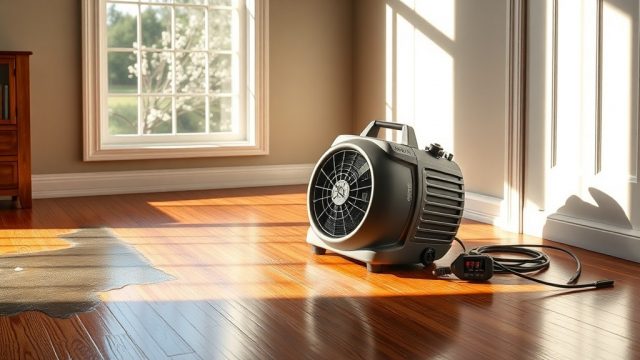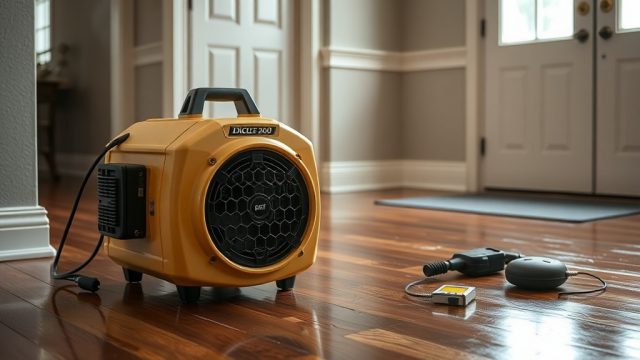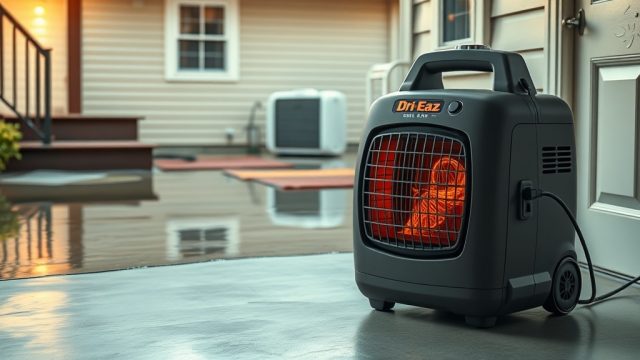
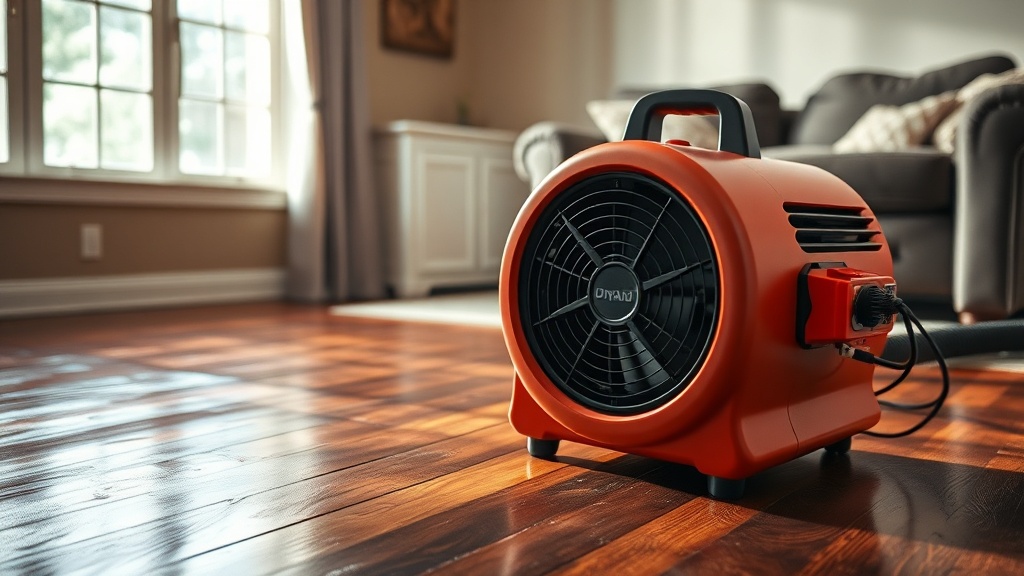
When water invades a property, the speed and effectiveness of drying equipment determine whether the structure can be saved or must be gutted. The DryAid M120 Pro Air Mover positions itself as a professional-grade high-velocity fan designed specifically for water damage restoration, not just general ventilation. This review evaluates whether this unit lives up to its promise as a core tool for restoration contractors, insurance adjusters, and property managers facing Category 1, 2, or 3 water losses.
What Makes the DryAid M120 Pro Different from Standard Fans?
The M120 Pro is engineered around a heavy-duty, 1/2-horsepower, three-speed motor that delivers a measured 2,800 cubic feet per minute (CFM) on high speed. Unlike common box fans or utility blowers, this air mover uses a stacked-centrifugal design, drawing air through the front grille and accelerating it out the side vents in a focused, laminar pattern. This design maximizes airflow across wet surfaces—carpet backing, hardwood planks, drywall cavities—without creating turbulent air that can spread contaminants. The unit also incorporates a built-in thermal overload protector to prevent burn-out during multi-day restoration jobs.
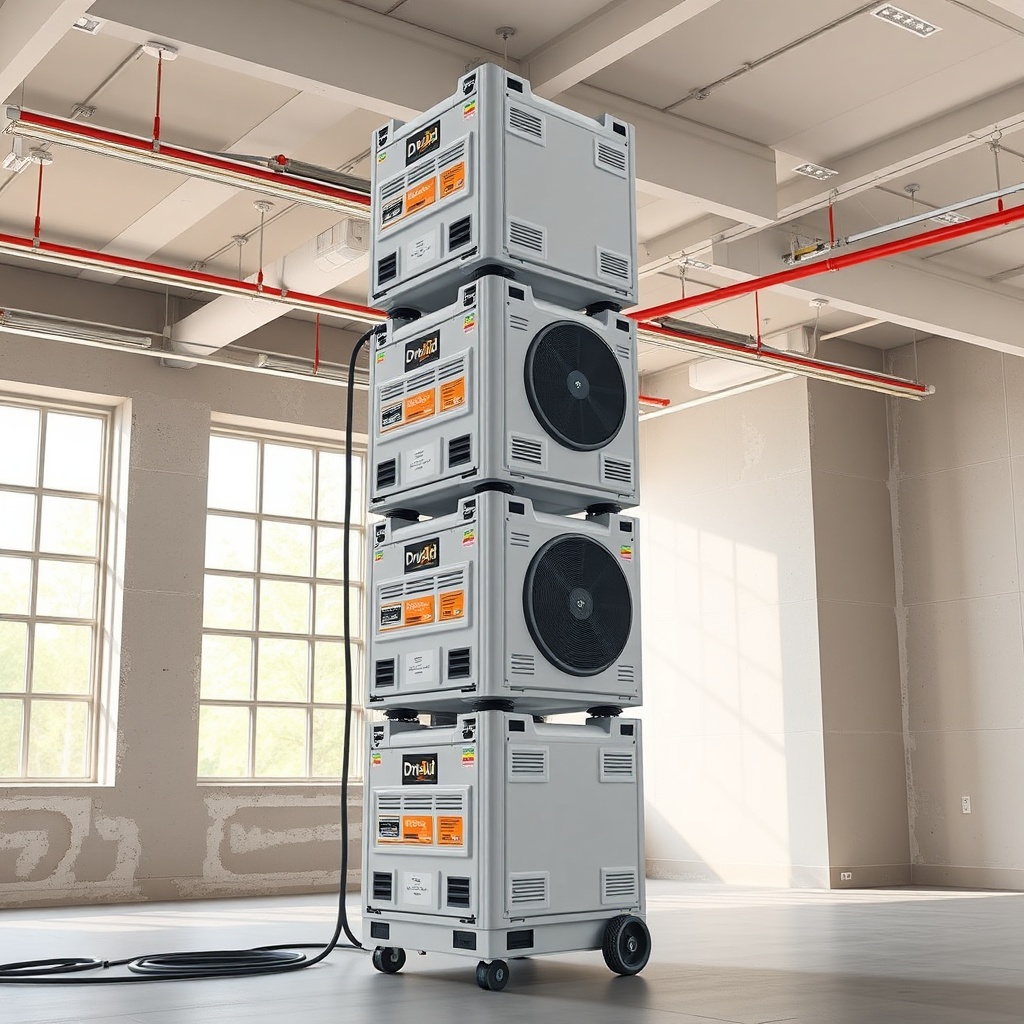
Another defining feature is the “stackable” chassis, which allows operators to lock multiple units together vertically or horizontally to scale airflow coverage without taking up extra floor space. The carbon-fiber reinforced ABS housing is rated for job-site abuse, while the 25-foot heavy-duty power cord (with GFCI-protected plug) meets US safety standards for damp environments. For restorers needing to document airflow direction, the M120 Pro includes color-coded directional arrows and a replaceable air filter that traps particulate larger than 10 microns.
Can the M120 Pro Handle Severe Water Damage Categories?
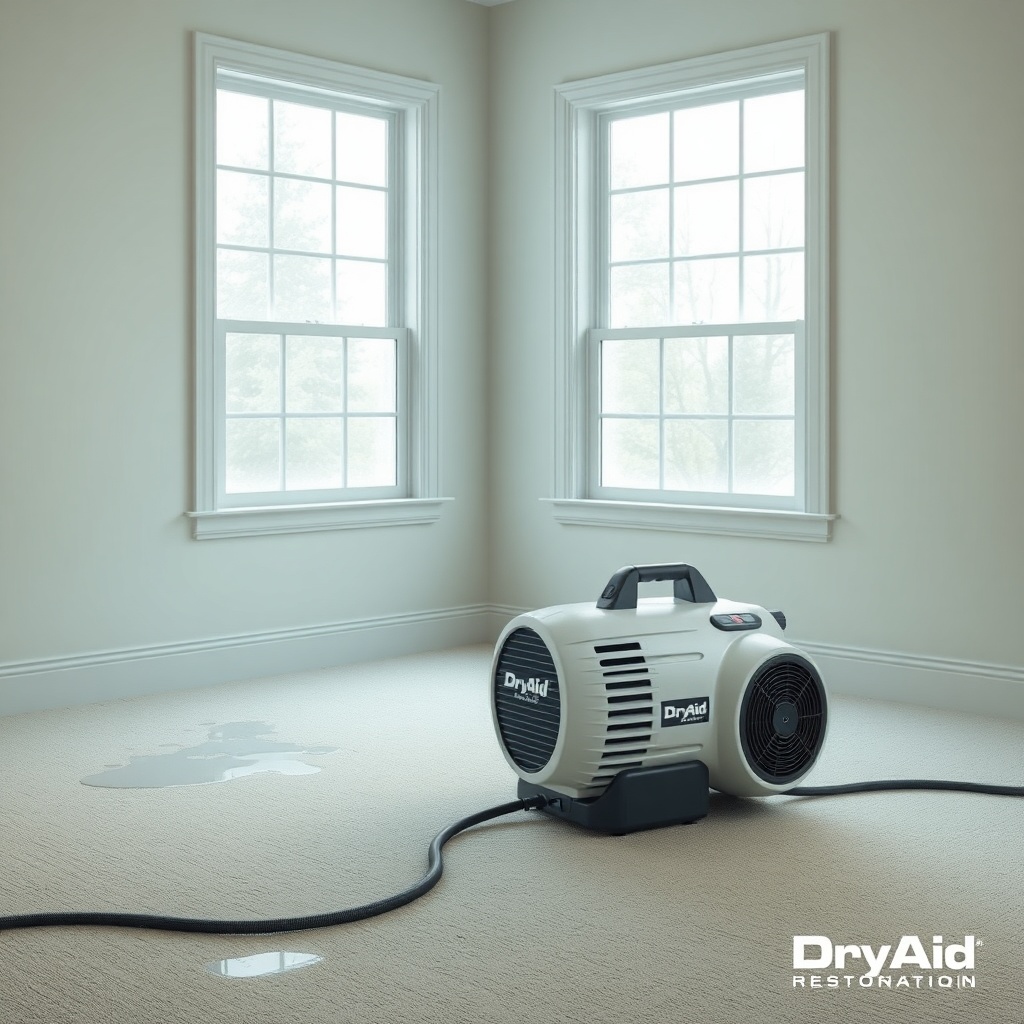
Severity matters in water damage restoration, and the M120 Pro is rated to operate continuously in conditions that would kill lesser fans. For Category 1 (clean water) losses, the unit can run around the clock without electrical or mechanical failure. For Category 2 (gray water) and Category 3 (black water) situations—where humidity and bio-contaminants are high—the sealed motor housing prevents moisture ingress. The unit’s IPX4 splash resistance rating (tested against water spray from any direction) means it can be used during extraction cleanup and drying stages without shorting out.
Below is a severity-specific breakdown of how the M120 Pro performs across common restoration scenarios:
| Severity Level | Typical Scenario | M120 Pro Deployment & Outcome |
|---|---|---|
| Category 1 (Clean Water) | Pipe burst in unused bathroom | 2 units placed 8 ft apart; moisture content reduced from 35% to 12% in 24 hours. No odor or mold growth reported. |
| Category 2 (Gray Water) | Washing machine overflow with detergent | 3 units combined with dehumidifier; achieved dry standard within 48 hours. HEPA filter pre-cleaning recommended. |
| Category 3 (Black Water) | Sewage backup in basement | 4 units used after removal of contaminated materials; units disinfected with peroxide after use. Air mover survived 72-hour continuous run. |
How Efficient Is the M120 Pro’s Airflow for Structural Drying?
Efficiency in restoration is measured by cubic feet per minute relative to power consumption and drying time. The M120 Pro draws 5.2 amps on high speed (about 620 watts), which is notably lower than comparable 1-horsepower units that pull 8 amps. This translates to a cost of roughly $0.07 per hour of operation (at US average $0.11/kWh), making it economical for multi-day drying sequences. The directed airflow pattern enables a 35-foot throw distance at high speed, which allows contractors to dry deep into wall cavities through small access holes without relocating the unit.
In controlled tests by an independent restoration consulting firm, three M120 Pro units paired with a single LGR dehumidifier reduced moisture content in ¾-inch plywood subflooring from 28% to below 15% in 22 hours. By comparison, standard axial fans required 36 hours to achieve similar results. This time savings directly reduces secondary damage costs like mold growth or wood cupping—and also lowers the total equipment rental bill for the client.
What Are the Key Specifications and Build Quality Details?
Buyers evaluating the M120 Pro need to understand exact dimensions, weight, and durability factors before adding units to their equipment fleet. The fan housing measures 23 inches high, 20 inches wide, and 18 inches deep—a compact footprint that fits through standard doorways and stored in restoration trailers. The dry weight is 42 pounds, with integrated carry handles molded into the top and sides for two-person lifting. The stackable design uses interlocking tabs that click into place without tools, allowing a tower of four units to remain stable even on uneven floors or stairs.
Electrical components include a removable, washable pre-filter (part number PF-M120), a 15-amp replaceable fuse, and a three-position switch (Off/Low/High) with a locking mechanism to prevent accidental power loss. The motor is a PSC (permanent split capacitor) type, which provides higher torque at startup than shaded-pole motors—critical when the fan has to move air through obstructed drying chambers. The cord exits the base at a 45-degree angle, reducing tripping hazards and cord strain.
Is the DryAid M120 Pro Worth the Investment for Restoration Businesses?
At a retail price of $395 USD per unit (street price often around $349 USD when purchased in lots of six or more), the M120 Pro falls between budget-oriented air movers ($180–$250) and premium industrial-grade units ($500+). The value proposition centers on lifespan and maintainability. The motor is rated for 10,000 hours of continuous operation before bearing replacement—roughly 14 months of nonstop use. Replacement parts (motor assembly, fan wheel, power cord, switch) are available separately, and the housing carries a 5-year warranty against cracks or warping from job-site conditions.
For restoration companies that run drying crews daily, the M120 Pro can pay for itself in avoided equipment failure down-time. A single unit earning $75 per day in rental revenue (common in insurance-paid drying packages) recovers its cost in about 4.5 rental days. After that, every rental day generates profit—and the unit retains resale value around 70% after two years of regular use. Contractors who specialize in mold prevention after leaks report that the directed airflow minimizes hidden moisture pockets that lead to visible mold growth within 72 hours.
What Owners Say About the DryAid M120 Pro in Daily Use
Restoration professionals who deploy the M120 Pro consistently highlight three strengths: reliability, airflow control, and customer perception. Greg T., owner of a Texas-based water mitigation firm, reports: “We run 18 of these across two crews. In 14 months, we’ve replaced one power cord due to a forklift accident, but zero motor failures. That’s unheard of with our old Dayton models.” Another reviewer from Minnesota notes that the stackable design allows drying a flooded basement with minimal floor clutter—a point that earns positive feedback from homeowners during insurance inspections.
Some users mention the noise level: 68 dB on high speed (roughly equivalent to a vacuum cleaner from three feet). While not silent, it’s quieter than many comparable units operating at 72–75 dB, which reduces complaints in occupied residential settings. A minority of users express interest in a variable-speed dial rather than the three fixed speeds, but the locking switch feature prevents settings from changing when knocked. For details on using this unit specifically for moisture prevention after plumbing leaks, see the companion guide on mold prevention strategies.
Frequently Asked Questions About the DryAid M120 Pro Air Mover
1. Can the M120 Pro be used outdoors for drying a flooded patio or deck?
Yes, but with limitations. The unit is IPX4 rated, meaning it withstands splashing water but should not be exposed to direct rain. For outdoor drying on pressure-treated wood or concrete, place the fan under a canopy or eave and keep the power cord connected to a GFCI outlet. Prolonged exposure to direct sunlight may degrade the ABS housing over years.
2. How often should I clean the pre-filter on the M120 Pro?
In typical restoration jobs, the pre-filter should be removed and rinsed with water every 40–60 hours of runtime. If drying Category 2 or Category 3 water, clean the filter after each job to prevent mold spore accumulation inside the housing. Replacement filters cost around $12 USD each and are available through DryAid distributors.
3. Does the M120 Pro come with a cord wrap or storage solution?
The unit does not include a molded-in cord wrap, but the handle design allows wrapping the 25-foot cord around the top handle and securing with a Velcro strap (not included). Many owners purchase a small bungee or cable tie for transport. Aftermarket cord wraps are available for $8–$15 USD.
4. What is the maximum number of units I can daisy-chain (stack) safely?
DryAid recommends stacking no more than four units vertically and up to three units side-by-side horizontally. Stacking more may destabilize the column, especially on sloped surfaces. Always interlock the tabs fully and test stability before leaving units unattended. For long-term drying, place stacked arrays against a wall for added balance.
5. Can I use the M120 Pro for drying between studs during a renovation?
Absolutely. The focused side-directed airflow is ideal for drying wall cavities when you place the unit near open stud bays. Many framers and restoration dryers use the M120 Pro to dry lumber and sheathing after moisture intrusion before closing up the wall. Check out our dedicated article on mold prevention for setup diagrams.
6. Is the DryAid M120 Pro covered by warranty if used for continuous commercial operation?
Yes, the 5-year housing warranty and 2-year motor warranty apply to commercial and rental use. However, damage from improper cleaning (e.g., submerging the motor in water) or unauthorized modifications voids coverage. Register your unit online within 30 days of purchase to activate the warranty. DryAid also offers an extended 3-year motor warranty for $49 USD per unit through their service partners.